When Intimacy Hurts: Understanding and Treating Vaginismus
By Alexis Lee
, Women’s Health Physiotherapist at Plan V
Experiencing painful or impossible penetration? Learn how specialized pelvic floor physiotherapy and dilator therapy effectively treat vaginismus pain-free.
Meet Hana
Hana, 28, had been married for fourteen months when she came to my clinic. She had been referred by her gynaecologist after two unsuccessful attempts at a smear test — both abandoned because the speculum could not be inserted.
She sat across from me with her hands folded tightly in her lap.
“We still haven’t been able to consummate our marriage,” she said quietly. “My husband thinks I don’t want him. I don’t know how to explain that I do — I just can’t.”
Then, barely above a whisper: “We are thinking of divorcing. His family is pressuring him. They say I am not a real wife.”
Her gynaecological examination had found no structural abnormality. Her pelvic organs were normal. The problem was not anatomical. It was neuromuscular, psychological, and entirely treatable — but nobody had yet told her that.
What was on the verge of ending her marriage was not a defect in her body. It was a well-understood, well-documented clinical condition that responds excellently to the right treatment. Hana had vaginismus. And the fourteen months she had spent believing she was broken were fourteen months in which she had simply not yet found the right door to walk through.
What Is Vaginismus?
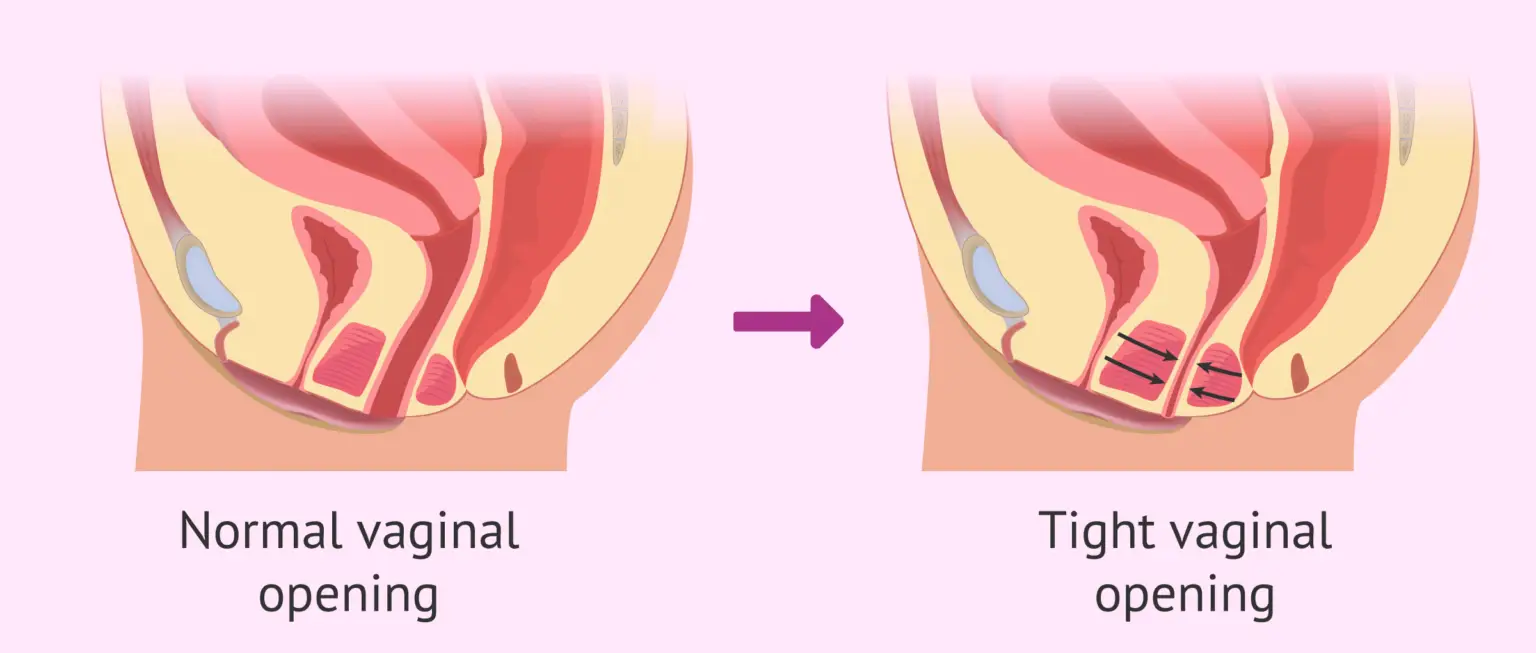
Figure 1: Normal Vaginal & Tight Vaginal Opening
Vaginismus(Figure 1) is the involuntary contraction of the muscles surrounding the vaginal opening — primarily the bulbospongiosus and superficial transverse perineal muscles, and frequently the deeper levator ani — in response to attempted or anticipated vaginal penetration. This contraction is not consciously controlled. The woman does not choose it. It happens automatically, often triggered by anticipation alone, before any physical contact occurs.
The result is that penetration — whether by a penis, a tampon, a finger, or a speculum — becomes impossible or severely painful. The muscles contract so forcefully that the vaginal opening effectively closes.
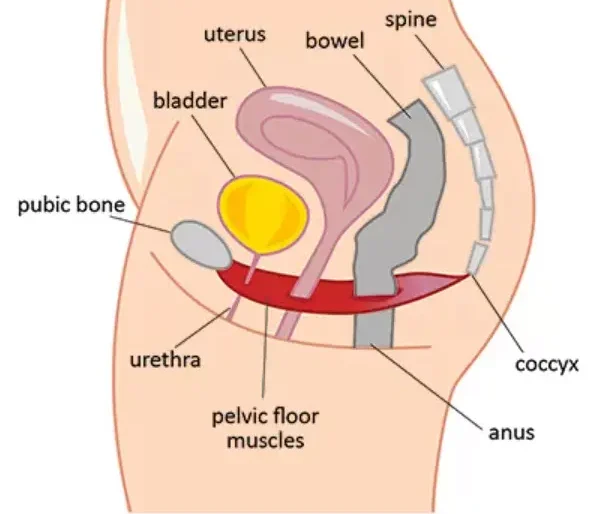
Vaginismus(Figure 2) is classified as either primary (penetration has never been possible) or secondary (previously possible but disrupted by childbirth, trauma, surgery, or menopause-related atrophy). Hana had primary vaginismus — she had never been able to tolerate any form of vaginal penetration, including tampons.
Figure 2: Female Pelvic Anatomy
Prevalence is likely significantly underestimated due to profound barriers to disclosure — particularly in Malaysian society, where female sexuality, marital intimacy, and reproductive function carry substantial cultural and religious weight. In clinical practice, the women I see have almost universally suffered in silence for years before presenting, many reaching crisis point in their marriages before seeking help.
Understanding the Cycle: Why Vaginismus Persists
Vaginismus is best understood as a self-perpetuating fear-avoidance cycle, not a fixed physical defect.
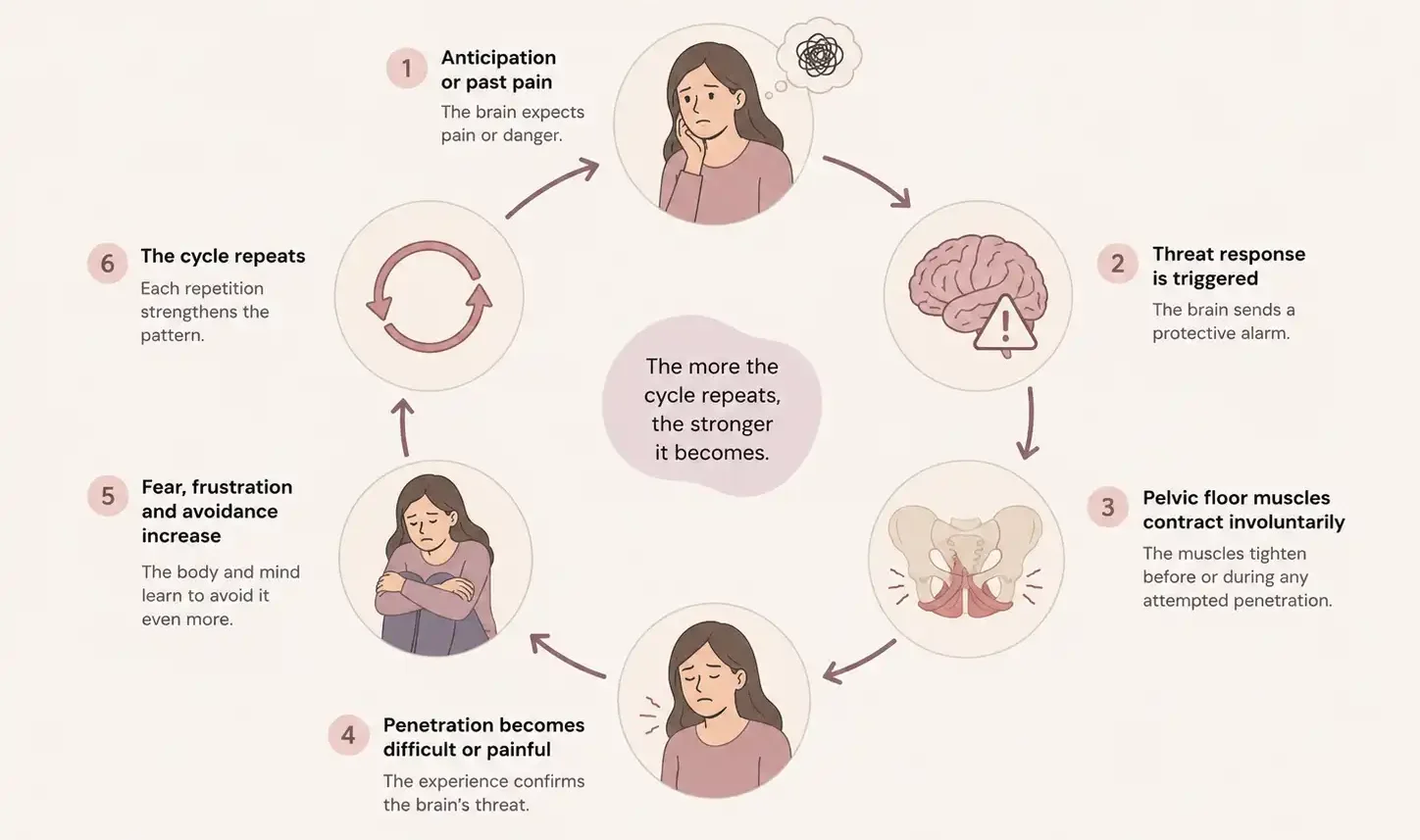
The cycle typically begins with an initial experience of pain or anticipated pain — from a first attempt at intercourse, a painful gynaecological examination, cultural or religious messaging that sex is painful, prior trauma, or sometimes no identifiable trigger at all(Figure 3). The brain registers penetration as a threat and activates a protective muscular response: the pelvic floor closes down.
Figure 3: The Fear-Avoidance Cycle in Vaginismus
On the next attempt, anticipation alone triggers the same response. The muscles contract before any contact occurs. Penetration fails or hurts. This confirms the brain’s threat prediction. Fear increases. Avoidance increases. The cycle tightens — and with it, frequently, the relationship fractures.
This is why vaginismus cannot be resolved through willpower, relaxation alone, or the well-meaning instruction to “just try to relax.” It requires a structured, progressive approach addressing the physical, cognitive, and emotional dimensions simultaneously.
Treatment: A Multimodal Approach
Hana’s treatment combined three integrated components delivered in parallel, with regular communication between her physiotherapist, gynaecologist, and the psychologist she was referred to concurrently.
Component 1 — Pelvic Floor Physiotherapy and Dilator Therapy
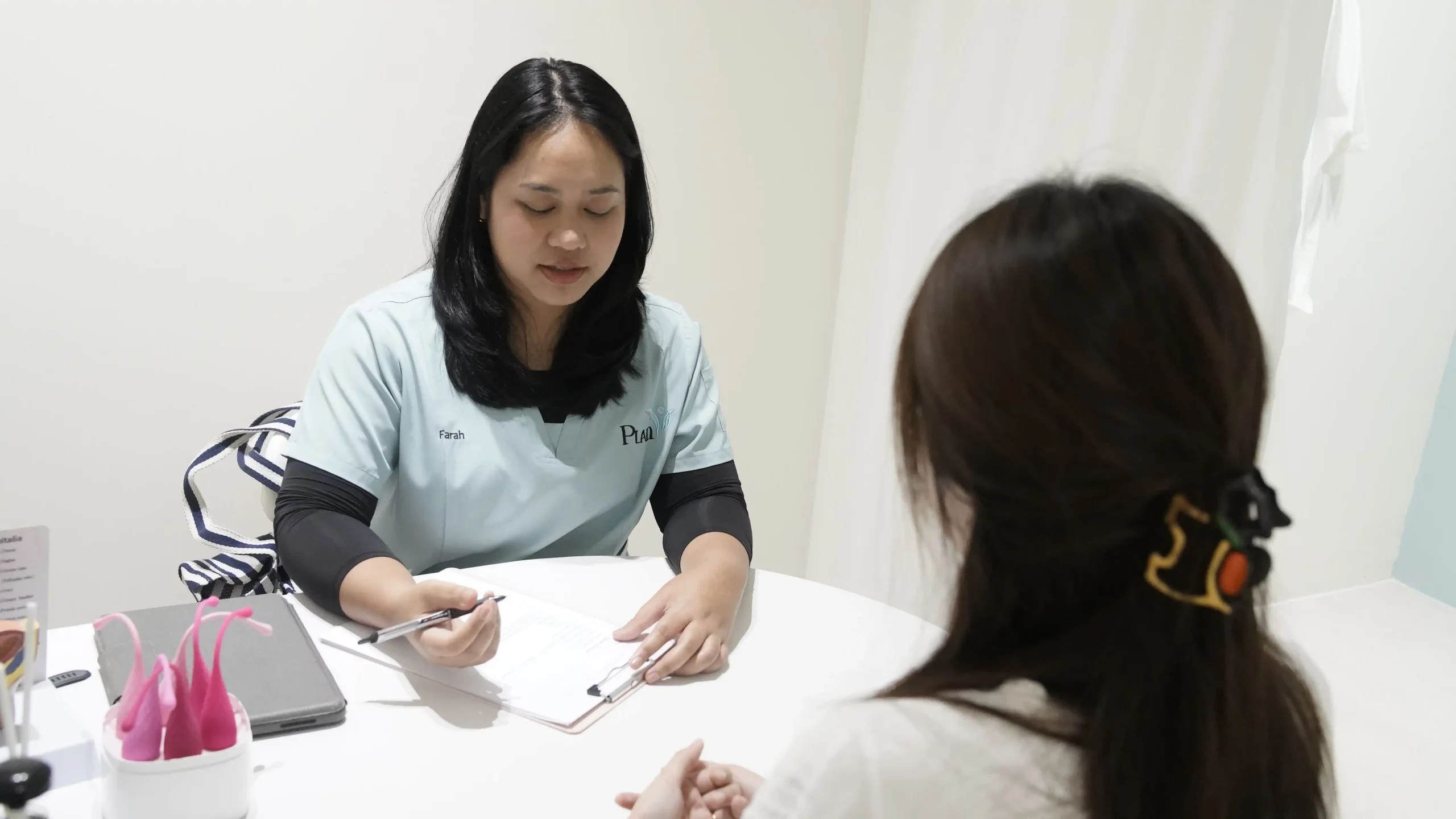
Assessment began with history and external examination only. Hana was explicitly told that nothing would happen without her full consent at every stage. This boundary-setting is clinically therapeutic: for a woman whose nervous system has learned that any approach to the vaginal area signals danger, experiencing control over the process begins to recondition that response.
External observation confirmed visible perineal contraction on simulated approach — muscles visibly tightening before any contact occurred. Seeing this on real-time ultrasound was itself a turning point for Hana. “So it’s really not in my head,” she said. “My body is actually doing something.” Correct. And because it was learned, it could be unlearned.
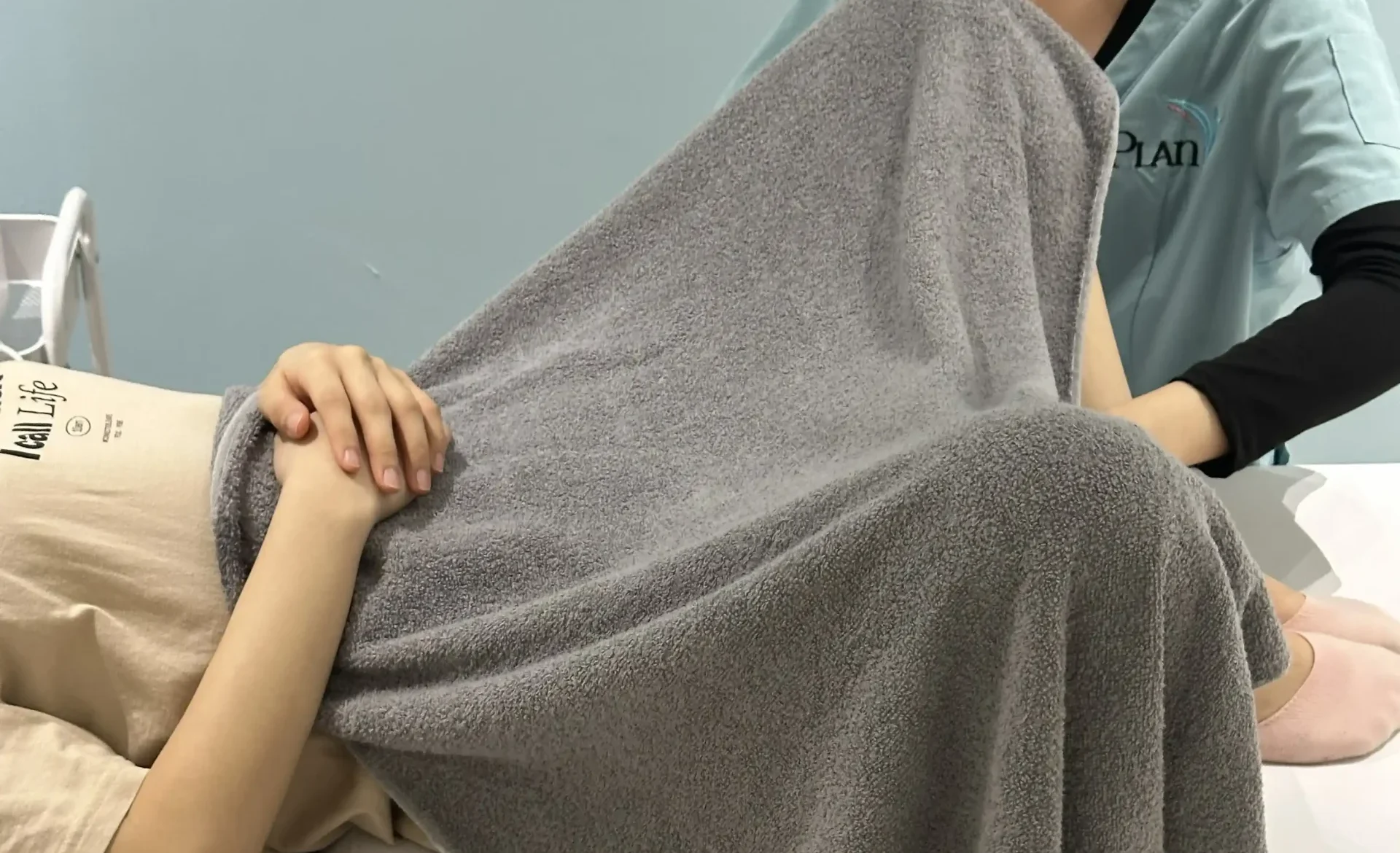
Pelvic floor downtraining(Figure 4) — the ability to consciously relax and lengthen the pelvic floor — was the first physical skill taught. Techniques included diaphragmatic breathing coordinated with pelvic floor release, visualisation of the pelvic floor opening and dropping, and progressive body awareness in supported positions. Many women with vaginismus have never consciously experienced pelvic floor relaxation. Learning it is both physically and psychologically significant.
Figure 4: Vaginismus Treatment
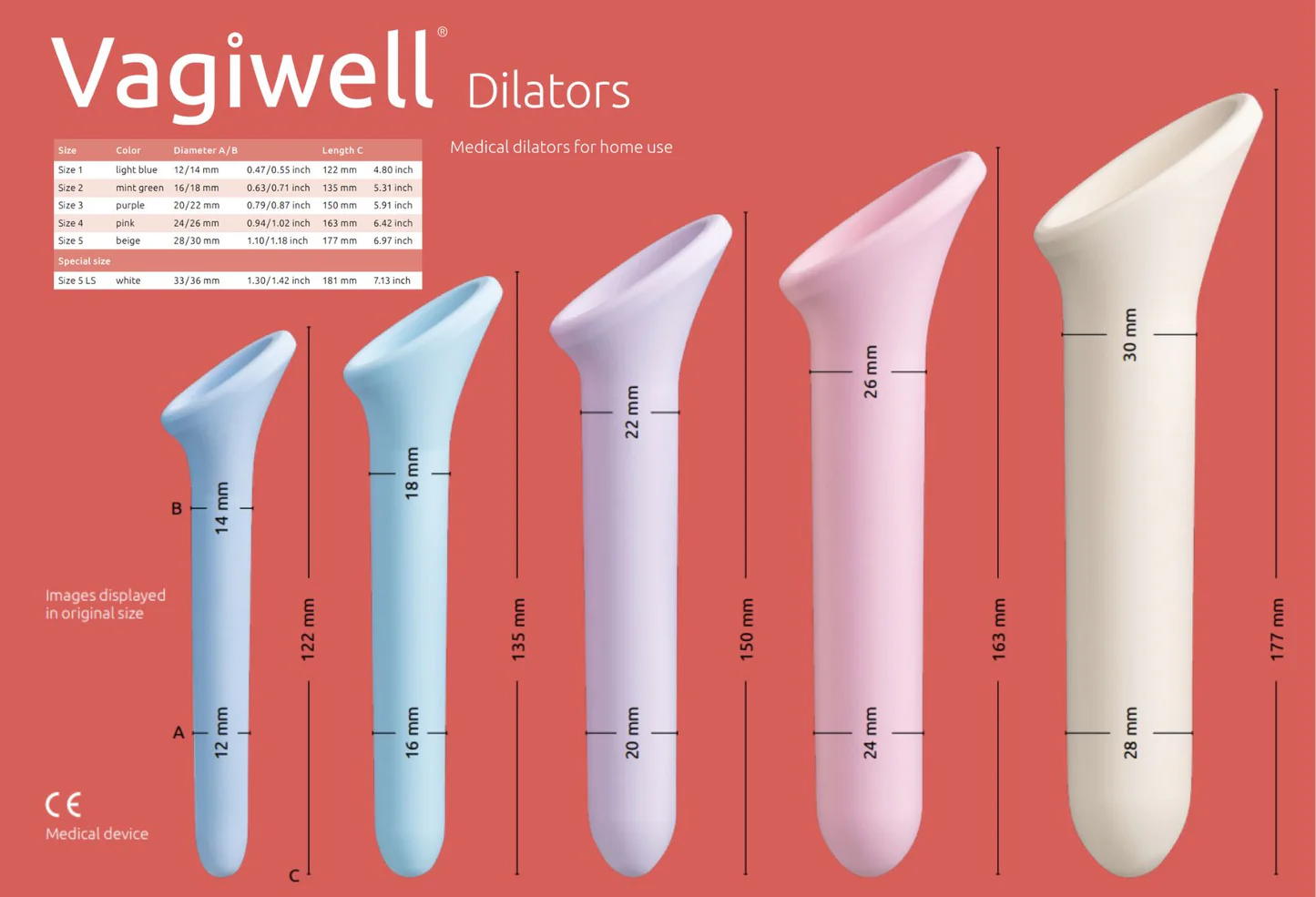
Vaginal dilator therapy is the cornerstone of physical desensitisation. Dilators are smooth, medical-grade silicone devices in progressive sizes — from narrower than a little finger to sizes approximating comfortable penetration. They are used by the patient at home, in privacy, at her own pace.
The process begins with the smallest size(Figure 5). With lubricant applied, in a comfortable supported position, practising her downtraining and breathing, Hana gently introduced the dilator only as far as comfortable — stopping at any resistance, never forcing. The goal was not depth or size. The goal was a comfortable, controlled experience of vaginal contact: a new data point for the nervous system that penetration does not equal pain.
Figure 5: Medical Vaginal Dilators With Different Size
Hana took three weeks at the smallest size before feeling ready to progress. This was not failure — it was the process working correctly. Key principles reinforced throughout:
Never push through pain. Discomfort from gentle stretching differs from sharp or burning pain; the latter is always a signal to stop.
Consistency over speed. Short daily sessions outperform infrequent longer ones.
Partner involvement, when ready, can be introduced gradually — transitioning from self-use to guided partner involvement in a controlled, consensual way that mirrors the eventual goal.
At week six, with Hana’s readiness and consent, her husband joined one session. He had been largely excluded from her treatment journey until that point — not by design, but because Hana had not known how to include him. What he witnessed and learned in that session shifted something between them. He understood, for the first time, that her body had been protecting itself — not rejecting him.
Component 2 — Cognitive Behavioural Therapy
Figure 6: Cognitive Behavioural Therapy (CBT)
CBT(Figure 6) addresses the cognitive and emotional architecture maintaining the fear-avoidance cycle — the catastrophic thinking, shame, and conditioned threat response that dilators alone cannot reach.
Hana’s psychological assessment revealed several maintaining cognitions: a belief that her body was defective, a fear that pain was inevitable and permanent, internalised cultural messaging that sex is painful for women and this is normal, and profound guilt about the impact on her marriage. She described lying awake calculating how many more months her husband might wait before the divorce became final.
CBT addressed four domains:
Psychoeducation reframed vaginismus from a character flaw to a learned protective pattern — one that could be unlearned. For Hana, understanding the neuroscience of conditioned pain responses was the first time she had felt something other than shame about her condition.
Cognitive restructuring identified and challenged automatic thoughts. “My body is broken” became “My body learned to protect itself. I am teaching it that protection is no longer needed.” These reconstruals were built through structured evidence examination, not reassurance.
Graded exposure worked systematically through a hierarchy of feared situations — from thinking about penetration, to self-touch, to dilator use, to partner involvement — each step approached when anxiety at the previous level had reduced sufficiently. This mirrored and reinforced the dilator therapy progression directly.
Relationship and communication work gave Hana language and tools to talk to her husband about vaginismus — what it was, what it was not, and what his role in her recovery could be. By session four she had disclosed her diagnosis fully to him for the first time. His response, informed by what she was now able to explain, transformed him from an unwitting source of pressure into her most important therapeutic ally.
Component 3 — Education
Education is not a preamble to treatment — it is treatment.
Core education covered anatomy and normal variation (addressing fears that her vagina was structurally different or too small), pain neuroscience (that pain in vaginismus is generated by the nervous system’s threat response, not tissue damage — pain does not mean harm), and cultural and religious messaging (compassionately challenging internalised beliefs that female sexual pain is normal, expected, or something to be endured).
Partner education, with Hana’s consent, was incorporated at week six. A partner who understands the involuntary nature of vaginismus, who does not interpret it as rejection, and who understands his role in graded exposure becomes a therapeutic resource rather than a source of pressure. Hana’s husband attended two education sessions. He asked careful, genuine questions. He left understanding that what had been happening in their marriage was not a failure of love — on either side.
The Turning Point
At week ten, Hana sent a message through our clinic’s patient communication system. It was three words:
“It worked. Alhamdulillah.”
She came in for her week twelve review composed in a way I had not seen in her before. The tightly folded hands were gone. She sat differently — with a stillness that came not from tension but from something closer to peace.
Penetrative intercourse had been achieved comfortably. Anticipatory anxiety, once so overwhelming that it triggered muscular contraction at the mere thought of her husband approaching her, had reduced to a level she described as manageable and decreasing. The divorce conversation had stopped entirely.
“He cried,” she told me quietly. “He said he never stopped believing we would get here.”
At sixteen weeks, Hana was discharged from both physiotherapy and CBT with a self-management plan, ongoing dilator maintenance protocol, and an open invitation to return if needed.
We did not hear from her for almost two years.
Two Years Later
The clinic door opened on a Tuesday afternoon and a young woman walked in carrying an infant — perhaps four months old, round-faced and milk-sleepy against her shoulder(Figure 7).
Figure 7: Mother Holding a Newborn Baby
It took me a moment to recognise her. Not because she had changed dramatically, but because the person who had sat across from me with her hands folded tightly in her lap, whispering about divorce, bore so little resemblance to the woman standing in front of me now.
It was Hana.
“I just wanted you to meet him,” she said, and her voice broke slightly on the last word. “His name is Rayyan.”
She had not come for an appointment. She had come because she wanted us to know. She wanted the physiotherapist who had supervised her dilator sessions, the receptionist who had always greeted her warmly, the clinic that had held space for her at her lowest point — she wanted all of us to see what had become possible on the other side of treatment.
We passed Rayyan around the clinic. He slept through all of it.
Before she left, Hana paused at the door.
“I almost didn’t come,” she said. “The first time, I mean. I was so ashamed. I thought you would judge me. I thought nothing could be done.”
She looked down at her son.
“Please tell other women. Whatever they are feeling — the shame, the fear, that it’s too embarrassing to say out loud — please tell them to come anyway. Because this,” — she gestured at Rayyan, at herself, at the space between where she had been and where she now stood — “this was waiting on the other side.”
For Clinicians: Breaking the Silence
Vaginismus is rarely volunteered. A simple screening question — “Do you experience any pain or difficulty with penetration or intercourse?” — opens the door. Normalising the disclosure and referring to a women’s health physiotherapist and psychologist with sexual health experience are the most impactful steps a clinician can take.
Surgery has no role in primary vaginismus management. Dilation under anaesthesia addresses muscular contraction temporarily but does not treat the fear-avoidance cycle; recurrence is common without concurrent physiotherapy and psychological input.
Conclusion
Vaginismus is not a defect, a punishment, or an irreversible condition. It is a neuromuscular and psychological response — learned, maintained, and most importantly, unlearnable — with an excellent prognosis when treated correctly.
Somewhere right now, a woman is sitting with her hands folded tightly in her lap, afraid to say the words, certain that her body is broken, watching her marriage strain under the weight of something nobody has yet offered to treat.
She is not broken. She is not alone. And there is a way through — if someone will only tell her to come in.
References: Reissing et al. (2004), Vaginismus: A Review of the Literature. Ter Kuile et al. (2009), CBT for Lifelong Vaginismus, Journal of Consulting and Clinical Psychology. Pacik PT (2014), Understanding and Treating Vaginismus. Written from clinical practice in women’s health physiotherapy, Malaysia.
At Plan V, you can take that step directly. You don’t need a referral, and you don’t need to have it all figured out first, just a private, judgment-free conversation with an all-female team, whenever you’re ready.
What is vaginismus, and is it a physical or psychological problem?
Vaginismus is an involuntary contraction of the pelvic floor muscles in response to attempted or anticipated penetration. It is a neuromuscular response involving both the physical body and the nervous system—meaning it is real, automatic, and not “all in your head.”
Can vaginismus be cured, and does it require surgery?
Vaginismus has an excellent success rate with conservative treatment and does not require surgery. Physical therapy, gradual desensitization (dilator therapy), and cognitive behavioral techniques effectively train the pelvic floor muscles to relax.
Is dilator therapy painful?
No, dilator therapy should never be forced or painful. Treatment moves at your own pace using progressive sizes, focusing on gentle desensitization and breathing techniques so your body learns that penetration is safe and comfortable.
How long does treatment for vaginismus usually take?
Recovery timelines vary for every woman, but many notice significant improvements within a few weeks to a few months of consistent, guided therapy and home practice.
Can I still get pregnant if I have vaginismus?
Yes. Once vaginismus is treated and comfortable intercourse is achieved, pregnancy is entirely possible naturally. Successful treatment also makes routine gynecological exams and cervical screening comfortable and stress-free.
Is pain during sex after pregnancy holding you back? Kegels may not help if your pelvic floor is too tight. Learn how pelvic physiotherapy and relaxation techniques can relieve post-partum discomfort.