
Clinical
Diastasis Recti Treatment
in Petaling Jaya

Reduce the abdominal gap, ease the postpartum bulge, and relieve persistent lower back strain through targeted, ultrasound-guided clinical rehabilitation.

Does this
sound familiar?

You know your body best. If any of these feel familiar, you’re in the right place.

Persistent
"Mummy Tummy"

A persistent “mummy tummy” or pooch that still makes you look pregnant months or years after giving birth.

Visible
stomach doming

A distinct dome, cone, or ridge down the centre of your stomach when you sit up in bed.
Lower back pain
and core weakness

Chronic lower back pain and a feeling of core weakness or instability, despite rest.

If this sounds like you,

it isn't about weight or willpower,

it’s a structural change, and it can be rehabilitated.

You're
not alone

Abdominal separation after pregnancy is extremely common, and it doesn’t simply “go away with time” for everyone. Many women are told to just do more crunches, which can actually make it worse. The good news is that with the right targeted rehabilitation, the gap can be safely reduced.

More common than you think

Not your fault, not something to be ashamed of

Effective treatment is available

Real change is possible

Understanding
Diastasis Recti

A gentle explanation of what’s happening inside your body.

What is it?

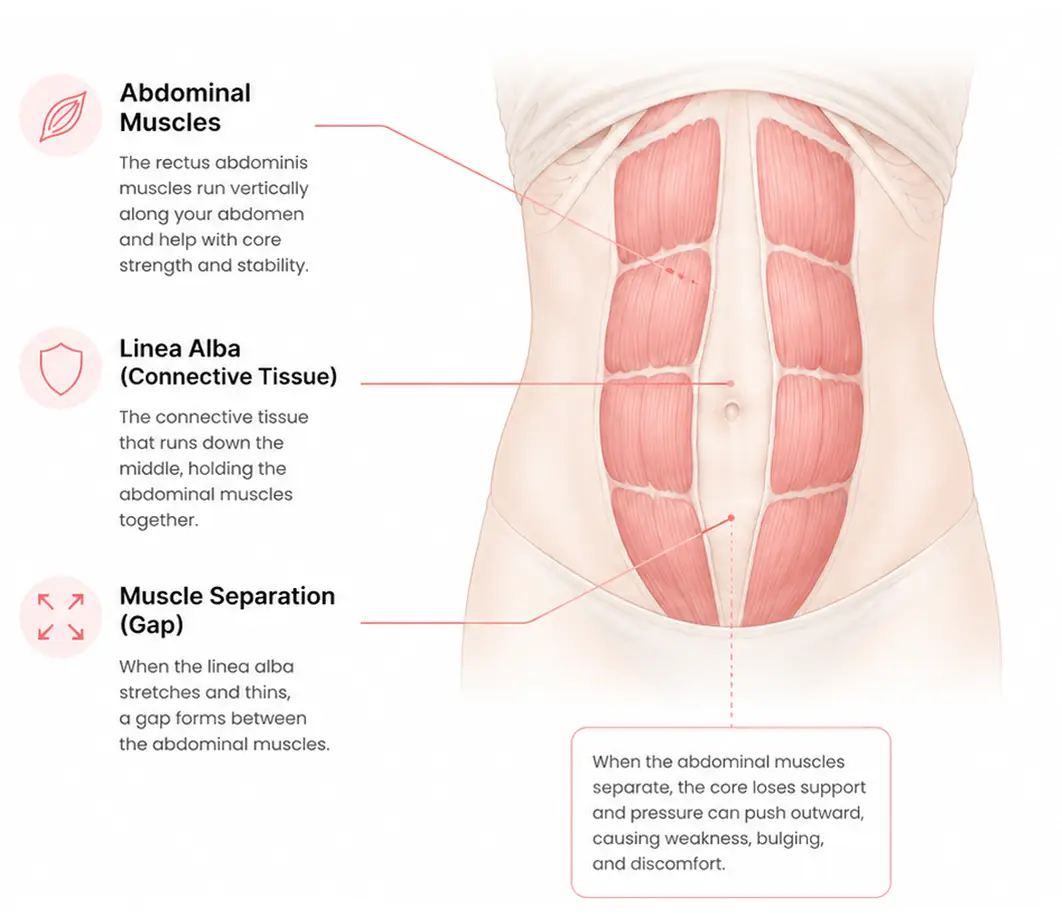
Diastasis recti is a separation of the abdominal muscles down the midline of your stomach, most often caused by pregnancy. When the gap doesn't close on its own afterwards, it can leave your core weak and your lower back unsupported. It is a structural issue, and it responds well to the right clinical movement.

Why it happens?

During pregnancy your abdominal muscles stretch and separate to make room for your baby. For many women the gap narrows naturally, but for others it stays open, leaving the deep core unable to stabilise the spine.

Why the usual advice falls short?

This is why traditional gym crunches, intense planks, or tight passive binding often don't help, and can even widen the gap, because they create unmanaged outward pressure on an already separated muscle. Closing the gap takes targeted, progressive loading of the right muscles.

How we help

The method - 3 Steps

01

Ultrasound (IRD) scan

We measure the exact width and depth of your separation, so we work from real numbers, not guesswork.

02

Deep core isolation

Using live ultrasound feedback, we teach you to activate the deep inner muscle without straining the superficial layer that worsens the gap.

03

Clinical Pilates rehabilitation

Progressive, specialised exercises that safely draw the muscle borders together, easing the bulge and stabilising your spine.

What to expect on your first visit

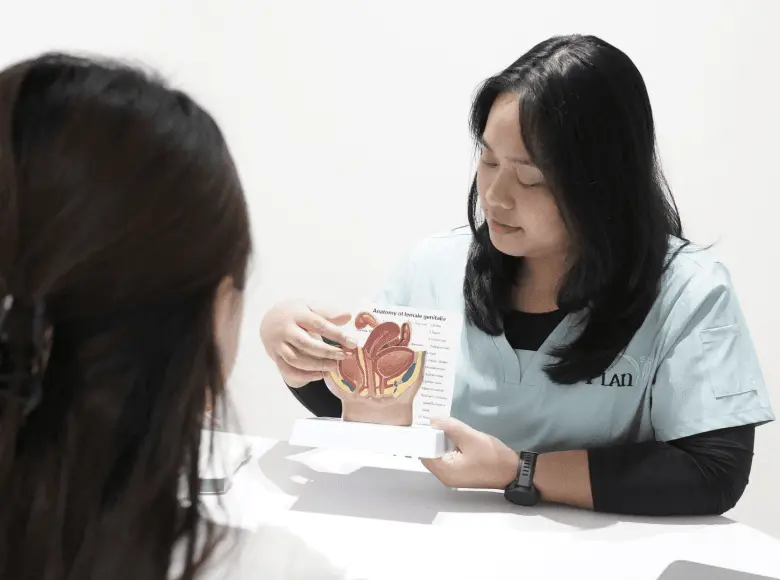
Unhurried and judgment-free conversation

Clear visual scanning of your recovery

Step-by-step guidance without rush

What progress looks like

We believe in realistic progress, guided by evidence and tailored to your body.

Every body recovers at its own pace

Your recovery depends on your unique body and separation size. We meet you where you are and never rush the process.

Objective progress through ultrasound

We track your gap with real-time ultrasound so you can visually watch your separation narrow over your programme.

Honest timelines and simple home routines

We measure the exact width and depth of your separation, so we work from real numbers, not guesswork.

Meet

Farah Zainuri,

Our women's
health physiotherapist

She specialises in functional training, pelvic dysfunction, and postnatal strains.

B.Phy (Hons)

APAM Registered

MMC Registered

Your questions, answered

Common questions. Honest answers.

After years of avoiding intimacy, I finally understood what was happening.
- Sarah
01 Can diastasis recti be fixed without surgery?
For most women, yes. Targeted clinical rehabilitation can safely reduce the separation without surgery.
No. Diastasis recti can be rehabilitated years after birth. It’s never too late to start.
Not without guidance. Done wrong, they can worsen the gap. We teach you the safe, effective movements instead.
No. You can book an assessment directly whenever you’re ready.

Your core
can recover

Start with a scan that shows you exactly what's going on.
No referral, no pressure.

60-min Assessment

Private & Confidential

No Referral Needed